-
NIU Journal of Management Sciences, Vol. 12, No. 3, September 2026Vol 12 No 3 (2026)
This edition of NIU Journal of Management Sciences touches on as Ecosystem Security in Digital Finance, Hyper-Personalized Marketing, Digital Marketing, Modern Fiscal Policy, Green Management Practices, Corporate Social Responsibility, Business Artificial Intelligence and Entrepreneurial Self-Efficacy.
One of the papers, in this issue, reveals that digital transformation improves business performance, with digital marketing tools and electronic payment systems providing the most immediate benefits. However, cloud-based record-keeping adoption remains low due to infrastructure deficits and data security concerns. It therefore, recommends prioritizing digital marketing and electronic payment adoption; improving electricity reliability and subsidizing data costs; and promoting hybrid cash-digital payment models alongside digital literacy training for small-scale business owners.
Another paper also reveals that both the bid-ask spread and exchange rate fluctuations significantly drive stock market volatility in the short and long run. The paper therefore, advocates for targeted policy interventions aimed at reducing market frictions through enhancements in trading infrastructure, the implementation of more effective regulatory frameworks, and the stabilization of key macroeconomic indicators especially interest and exchange rates as mechanisms to mitigate volatility and strengthen the resilience of Nigeria’s capital market.
On the whole, this edition of NIU Management Sciences features many empirical and theoretical based articles which can be of great benefit to every reader.
-
NIU Journal of Management Sciences, Vol. 12, No. 2, June 2026Vol 12 No 2 (2026)
This edition of NIU Journal of Management Sciences touches on as Marketing Orientation, Consumer Behaviour, Digital Entrepreneurship Orientation, Public Debt Management, Tax Audit Effectiveness and Tax Compliance Behaviour.
One of the papers, in this issue, examines how social media exposure and digital entrepreneurship orientation influence youths’ intentions to engage in irregular migration in Plateau State, Nigeria. It therefore, recommends enhanced digital entrepreneurship education and youth-targeted programs to curb irregular migration by creating viable local opportunities.
Another paper also reveals that that institutional quality, as measured by the corruption ranking index, has a significant inverse effect on health outcomes in both the long and short run. In contrast, the fiscal freedom index shows a direct, though insignificant, impact on health outcomes in the long run, becoming significant in the short run. The paper therefore, recommends that thorough assessment of debt-financed health projects for sustainability, prioritization of low-interest public loans for health financing, reduction in reliance on external debt for health expenditures, enhancement of transparency and accountability in health spending, and institutional reforms to combat corruption and improve the efficiency of public health investments and its outcome.
On the whole, this edition of NIU Management Sciences features many empirical and theoretical based articles which can be of great benefit to every reader.
-
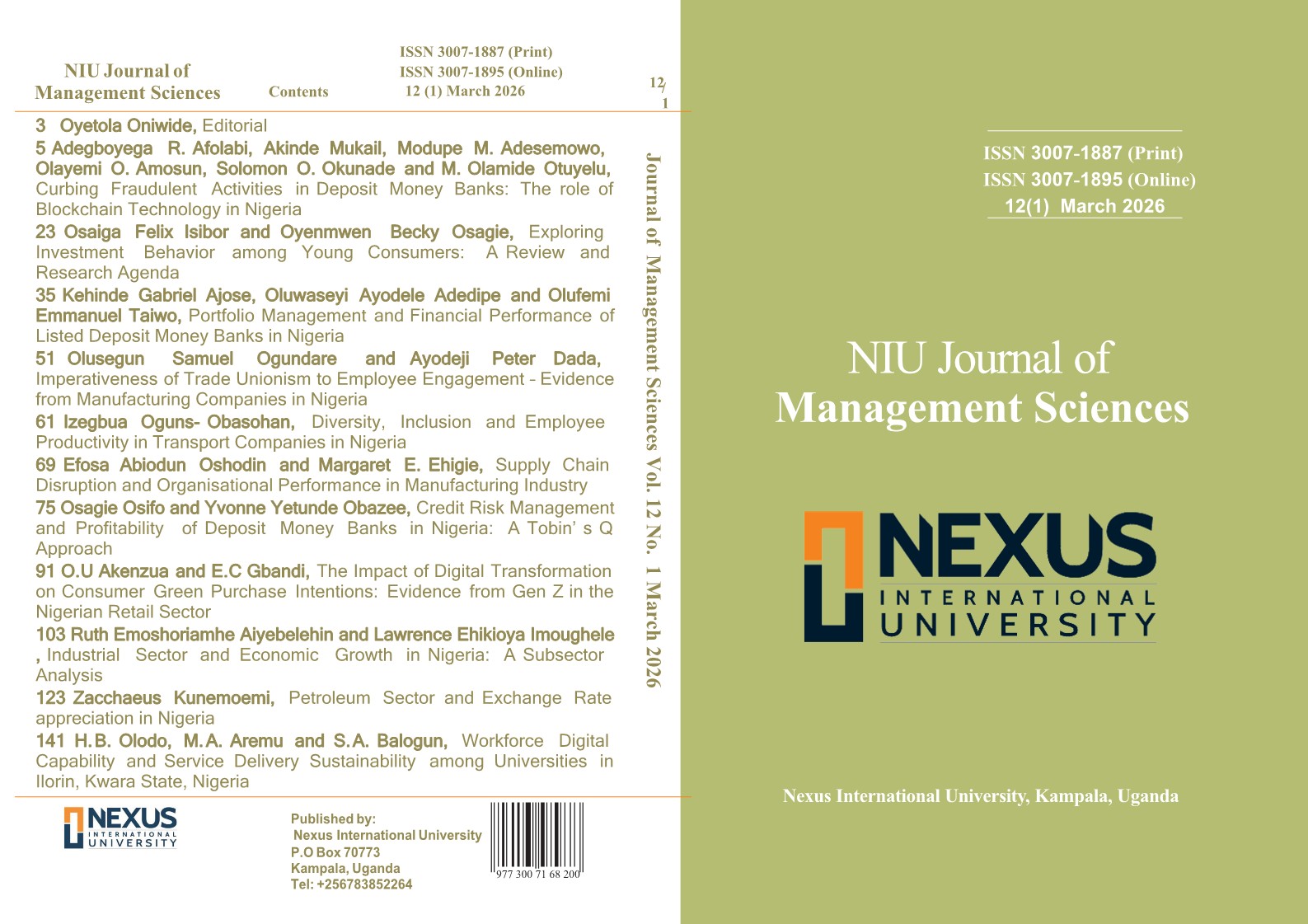 NIU Journal of Management Sciences, Vol. 12, No. 1, March 2026
Vol 12 No 1 (2026)
NIU Journal of Management Sciences, Vol. 12, No. 1, March 2026
Vol 12 No 1 (2026)This edition of NIU Journal of Management Sciences touches on as Investment Behavior, Supply Chain Disruption, Credit Risk Management, Portfolio Management and Financial Performance as well as Blockchain Technology and Curbing Fraudulent Activities in Deposit Money Banks.
One of the papers, in this issue, clarify how rational, behavioural, cognitive, and social factors shape young people’s investment intentions as well as choices, while identifying gaps in research conducted so far that can inform future research agenda. It therefore, recommends greater theoretical integration, the adoption of mixed-method and longitudinal approaches, and increased attention to digital investment platforms.
Another paper also reveals that trade unionism enhances employee engagement and ensure production-stimulated work environment because labour organization always pressured organization to do the right thing; but collective bargaining is losing its potency as employers of labour always most time have reasons to renege on their promise for better welfare package mostly in developing world due to weak contract enforcement mechanism. The paper therefore, recommends that the management must do everything within its power to manage labour movement in the organization through employee engagement, ensuring employee welfare, working conditions and timely compensation and other benefits so that trade unionism does not turn to be a menace to organizational stability.
On the whole, this edition of NIU Management Sciences features many empirical and theoretical based articles which can be of great benefit to every reader.
-
 NIU Journal of Management Sciences, Vol. 11, No. 2, December 2025
Vol 11 No 2 (2025)
NIU Journal of Management Sciences, Vol. 11, No. 2, December 2025
Vol 11 No 2 (2025)This edition of NIU Journal of Management Sciences touches on as Financial Inclusion, Customers’ Care Support, Human Resource Management as well as Government Support Initiatives and Sustainability of Small Businesses.
One of the papers, in this issue, examines how components of employee capital such as employee knowledge, employee skills and employee capabilities influenced customer satisfaction. Corresponding research questions and hypotheses were developed and tested. It is recommended that bank management should increase their efforts in developing their employee capital to enhance customer satisfaction
Another paper also reveals that financial inclusion measures affected the economic development in Nigeria. It is recommended that government should focus on the financial inclusion policies as a means of ameliorating poverty, through a participation of all economic agents in the financial system. The paper therefore, recommends that there is a need for the government of Nigerian to prioritize the importance of financial inclusion.
On the whole, this edition of NIU Management Sciences features many empirical and theoretical based articles which can be of great benefit to every reader.

1 - 4 of 4 items
Language
Information

